Hair and beauty training courses provide a practical route into employment, further education and self-employment. For learners who need a more applied approach, they can also provide a structured alternative to purely classroom-based study.
Younique Talent Training CIC is an approved ASDAN and AQA delivery centre, offering hair, beauty, barbering and nails pathways from entry level up to Level 3. Programmes combine practical vocational activity, online learning, assessment and progression tracking so that achievement is not only developed but evidenced.
This makes the provision relevant to several audiences:
- Employers and salon owners seeking staff with practical skills, recognised achievement and professional awareness.
- Schools and local authorities commissioning accountable alternative provision for learners at risk of exclusion, permanently excluded learners or home-educated children.
- Young people looking for vocational education courses that lead towards work, apprenticeships, further study or self-employment.
What are hair and beauty training courses?
Hair and beauty training courses are structured programmes that develop technical, theoretical and employability skills for the personal care sector. Depending on the level and pathway, learners may study:
- Hairdressing and styling
- Barbering and grooming
- Beauty treatments and client care
- Nail services and nail art
- Health, safety and hygiene
- Consultation and communication
- Professional conduct and presentation
- Product, equipment and workplace awareness
- Enterprise and self-employment skills
A quality programme does not focus on practical technique alone. Learners must also understand safe working practices, client expectations, preparation, cleaning, communication and the responsibilities associated with working in a professional environment.
At Younique Talent, delivery can include classroom-based practical learning, tutor support and flexible online activities. This blended model enables provision to be adapted to learner needs, available facilities, programme duration and commissioning requirements.

A clear pathway from Entry Level to Level 3
The most effective vocational training courses UK providers deliver are structured around realistic progression. Not every learner should begin at the same level, and completion alone does not demonstrate readiness for the next stage.
A typical pathway may include:
| Stage | Main purpose | Typical progression outcome |
|---|---|---|
| Entry Level | Introduce sector skills, confidence and participation | Progression to Level 1, further engagement or supported work-related learning |
| Level 1 | Develop basic technical and employability skills | Progression to Level 2 or an introductory workplace opportunity |
| Level 2 | Build occupational competence and independence | Employment, apprenticeship or progression to Level 3 |
| Level 3 | Develop advanced technical, creative and professional capability | Skilled employment, self-employment, supervision or further study |
Entry requirements, qualification content and assessment arrangements vary by programme. A responsible provider should complete an initial discussion or assessment before recommending a route.
The correct starting point is the level at which the learner can engage, achieve and progress, not simply the highest available qualification.
Entry Level hair and beauty provision for alternative education
Entry Level programmes are often appropriate for learners who have experienced interrupted education, low confidence, additional learning needs or difficulty engaging with conventional academic programmes.
For alternative provision schools, practical hair and beauty learning can provide:
- A clear purpose for attending sessions
- Short, achievable learning outcomes
- Opportunities to practise and repeat skills
- Evidence of incremental achievement
- A foundation for English, maths and employability development
- A route towards further vocational study
ASDAN’s offer includes skills-based education, accredited programmes and regulated qualifications from pre-Entry to Level 3. AQA’s Unit Award Scheme also enables learners to receive certificates for completed units, with outcomes and evidence clearly recorded.
These approaches can be particularly useful where a learner needs recognition for smaller steps before attempting a larger qualification. An AQA unit certificate is not automatically equivalent to a regulated qualification, so schools and commissioners should confirm the status and purpose of each programme. Used correctly, however, unit-based recognition can support engagement, confidence and a documented learning journey.
For learners at risk of exclusion or those who are home educated, the programme should be designed around measurable targets. These may include attendance, punctuality, safe tool use, communication, practical technique, independence and progression towards a qualification or destination.
Hairdressing, barbering, beauty and nails pathways
A broad programme allows learners to explore different areas before committing to a specialist route.
Hairdressing
Hairdressing pathways may introduce sectioning, styling, shampooing, basic cutting principles, hair care, consultation and professional presentation. More advanced learning can develop creative cutting, colouring, treatment planning and salon practice, subject to the requirements of the qualification.
Barbering
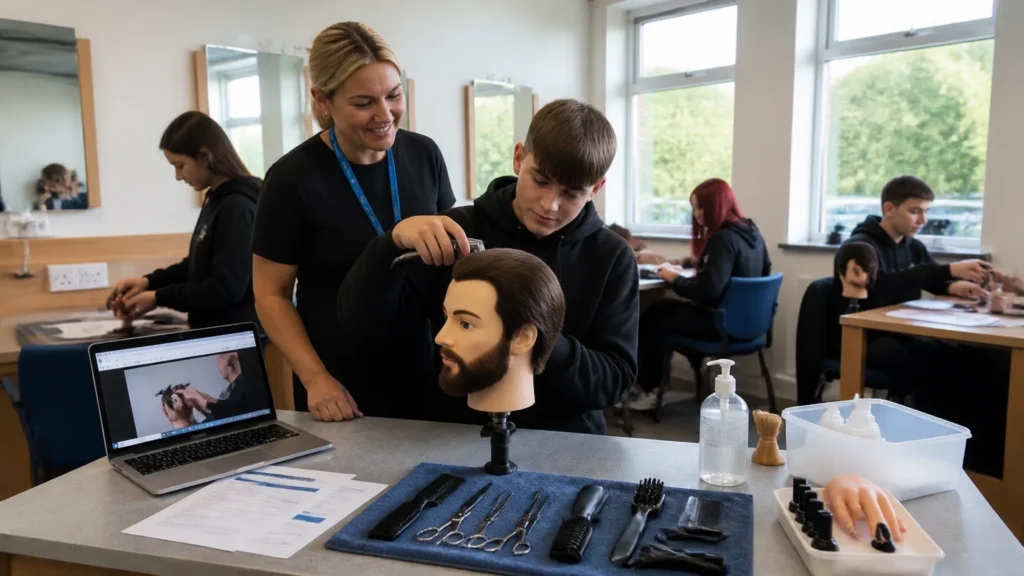
Barbering can be an accessible and motivating route for learners interested in clipper work, fades, styling, beard grooming and men’s hair services. Programmes should include hygiene, consultation, safe equipment use and the importance of working within the learner’s assessed competence.
Learners can also explore the operational side of a barbershop, including appointment management, customer service, stock control and promotion.
Read more about the pathway in our guide to a barbering course in the UK.
Beauty
Beauty training can cover skincare, client care, facial services, make-up, consultation, product knowledge and treatment preparation. The precise content depends on the programme level and qualification specification.
Learners should understand that professional beauty work involves more than applying products. Hygiene, contraindications, record keeping, communication and safe practice are essential.
Our related guide explains the potential benefits of beauty training near Manchester.
Nails
Nail pathways can include basic manicure, nail preparation, polish application, nail art and client consultation. Nails can be an effective introduction to precision, patience, presentation and customer-focused work.
Where learners progress to more advanced services, providers must ensure that equipment, products, supervision and assessment arrangements are appropriate to the qualification requirements.

What should employers and salon owners look for?
Employers need more than a certificate. They need new staff to understand safe working practices, professional behaviour and the expectations of clients.
When reviewing a training provider, assess whether the programme includes:
- Recognised accreditation: Confirm the awarding or certification body and the status of the achievement.
- Practical assessment: Check how technical competence is observed, assessed and recorded.
- Health and safety: Ensure hygiene, sanitation, equipment safety and risk awareness are included.
- Professional behaviours: Look for punctuality, communication, teamwork and customer care.
- Progression evidence: Review how learner development and outcomes are documented.
- Flexible delivery: Establish whether online and practical elements can be arranged around operational requirements.
- Appropriate supervision: Confirm that learners practise within a safe and clearly defined environment.
A well-designed programme reduces the gap between training and workplace expectations. It gives employers clearer evidence when recruiting and gives learners a more realistic understanding of professional responsibility.
What should schools and local authorities assess?
Alternative provision is not simply a change of location. It must remain suitable, safeguarded, accountable and linked to the learner’s wider education and progression plan.
The Department for Education’s statutory guidance on alternative provision applies to schools, local authorities, academy trusts, pupil referral units, colleges and independent providers delivering alternative provision in England.
Commissioners should assess:
- Safeguarding arrangements and the provider’s procedures for responding to concerns.
- Staff suitability and competence, including relevant checks and training.
- Individual learner planning, including needs, starting points and intended outcomes.
- Attendance and engagement monitoring, with concerns escalated promptly.
- Assessment and evidence, rather than relying only on course attendance.
- Progression planning, including further education, employment, apprenticeships or supported destinations.
- Reporting arrangements, so the school or local authority can review progress and value for money.
Schools should also consider the timing of statutory safeguarding guidance. As at August 2026, Keeping Children Safe in Education 2025 remains in force until 31 August 2026, with the 2026 version coming into force on 1 September 2026.
Safeguarding must be embedded in delivery. It cannot be treated as a separate administrative document.
How Younique Talent supports measurable progression
Younique Talent provides more than access to vocational content. We support structured delivery that can be aligned with organisational, education and learner requirements.
Our approach can include:
- ✅ Entry Level to Level 3 progression planning
- ✅ Hair, beauty, barbering and nails pathways
- ✅ ASDAN and AQA delivery options
- ✅ Flexible blended learning
- ✅ Practical skills development and assessment
- ✅ Structured learner records and progress reviews
- ✅ Safeguarding-led delivery
- ✅ Reporting for schools, commissioners and employers
- ✅ Progression planning towards work or further study
We do not just provide a course. We support a process of engagement, assessment, achievement and progression.

Frequently asked questions
Are hair and beauty training courses suitable for learners with no previous experience?
Yes. Entry Level programmes are designed to introduce foundational skills and sector knowledge. Initial discussions should identify the learner’s starting point, support needs and realistic progression route.
Does Younique Talent offer Level 3 training?
Yes. Younique Talent offers hair, beauty, barbering and nails qualifications from entry level up to Level 3, subject to programme availability, qualification requirements and assessment arrangements.
Are the programmes accredited?
Yes, where an accredited programme is selected. Younique Talent is an approved ASDAN and AQA delivery centre. Schools, employers and learners should confirm the exact qualification, unit or certificate being delivered before enrolment.
Can schools commission provision for learners at risk of exclusion?
Yes. Programmes can be designed for alternative provision settings, including learners at risk of exclusion, permanently excluded learners and young people requiring a more practical route into education or employment. Safeguarding, reporting and progression requirements should be agreed before delivery begins.
Can training combine online and practical learning?
Yes. Blended delivery can combine tutor-led practical activity, online learning, assessment and structured support. This provides flexibility while retaining practical evidence and accountability.
Can the training lead to employment or further study?
Yes. Depending on the learner’s starting point and achievement, progression may include further vocational qualifications, college, apprenticeships, salon employment, barbering, beauty services or self-employment.
Strengthen your vocational pathway
The right vocational education courses give learners a practical starting point, recognised achievement and a clear next step. They also give employers, schools and local authorities stronger evidence of what has been delivered and achieved.
Younique Talent can help employers, salon owners, schools and commissioners review their requirements and develop a flexible programme aligned with learner needs, safeguarding expectations, qualification objectives and progression goals.
Explore Younique Talent’s training and qualification provision or discuss how a structured hair, beauty, barbering or nails pathway can support your organisation.