
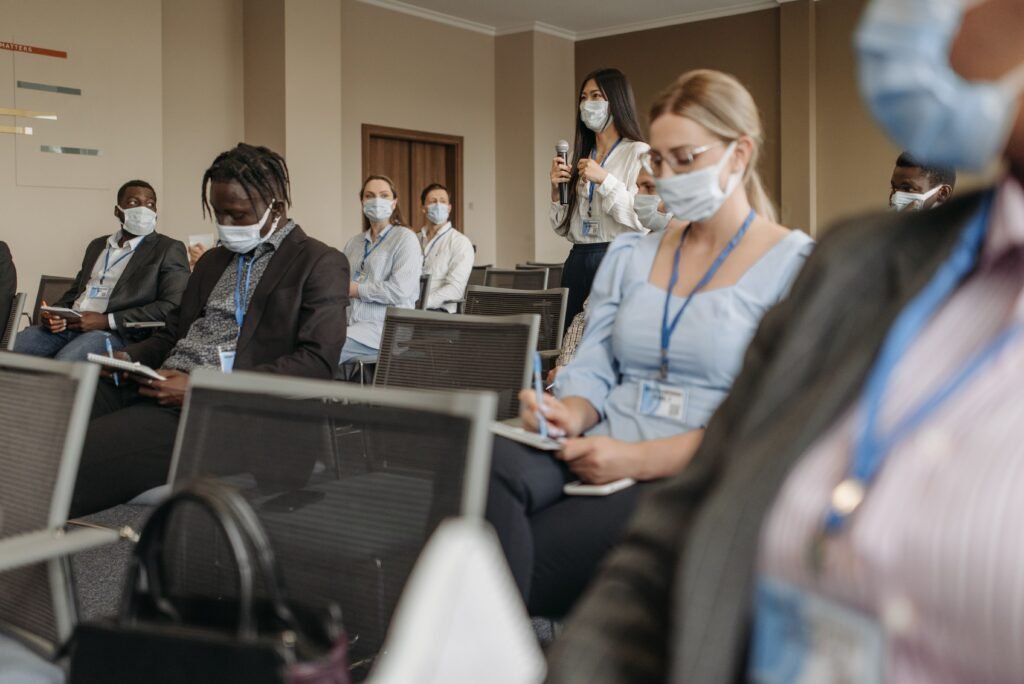
In 2024 to 2025, 680,000 workers across Great Britain sustained a workplace injury an increase of more than 12% on the previous year, according to data published by the Health and Safety Executive. The estimated total cost of workplace injuries and ill health from current working conditions reached £22.9 billion. Work-related stress, depression, and anxiety affected 964,000 workers the highest recorded figure in recent years, and one that continues to rise.
For businesses in Manchester and across Greater Manchester, those national figures translate into a direct operational and legal reality. Under the Health and Safety at Work Act 1974, every employer regardless of sector or headcount has a legal duty to provide a safe working environment, assess workplace risks, and ensure their employees have the information, instruction, and training they need to work safely. Non-compliance carries consequences that range from HSE enforcement notices and court fines averaging £150,000 to personal liability for directors and, in the most serious cases, imprisonment.
This guide covers everything Manchester businesses need to know about health and safety training what the law requires, which courses apply to which roles and industries, what training costs in 2025 and 2026, how online delivery compares to classroom options, and how to find the right training provider for your organisation.
What the Law Requires: Health and Safety Training Obligations for Manchester Businesses
Health and safety training obligations for UK employers are not discretionary guidance. They are legal requirements embedded in a framework of legislation that the HSE actively enforces across all regions, including Greater Manchester.
The Health and Safety at Work Act 1974 establishes the primary duty: employers must, so far as is reasonably practicable, ensure the health, safety, and welfare at work of all their employees. Section 2 specifically requires employers to provide adequate information, instruction, training, and supervision. This obligation applies from day one of employment there is no grace period for new starters.
The Management of Health and Safety at Work Regulations 1999 go further, requiring employers to carry out suitable and sufficient risk assessments, put in place preventive and protective measures, and provide health and safety training that is repeated periodically where appropriate, adapted to take account of new risks, and given in a manner that is comprehensible to all employees.
Additional legislation creates specific training obligations by activity or hazard type:
- The Health and Safety (First Aid) Regulations 1981 require employers to ensure adequate first aid provision including trained first aiders appropriate to the workplace risk profile
- The Regulatory Reform (Fire Safety) Order 2005 requires fire safety instruction and training for all employees in premises where staff are present
- The Manual Handling Operations Regulations 1992 require employers to avoid manual handling operations that create a risk of injury where reasonably practicable, and to provide training where manual handling cannot be avoided
- The Control of Substances Hazardous to Health (COSHH) Regulations 2002 require training for employees who work with or may be exposed to hazardous substances
For Manchester businesses operating across construction, manufacturing, logistics, hospitality, health and social care, or any other sector where HSE scrutiny is active, the ability to demonstrate documented training compliance is not just a legal protection it is an operational necessity.
The HSE’s 2024 to 2025 Data: Why Manchester Employers Cannot Ignore Training
The national statistics from the HSE’s 2024 to 2025 report establish the context within which Manchester employers are operating. Beyond the headline figures, the data reveals patterns that directly inform training priorities for local businesses.
Work-related musculoskeletal disorders the category that includes manual handling injuries, back injuries, and repetitive strain affected 511,000 workers in 2024 to 2025, according to the HSE’s summary statistics for Great Britain 2025. Despite a slight improvement from the previous year’s 543,000 cases, musculoskeletal disorders remain the second most prevalent cause of work-related ill health after stress and anxiety. For Manchester businesses operating in warehousing, distribution, construction, and care, manual handling training is not optional it is the direct intervention that reduces the injury category most likely to affect their workforce.
Slips, trips, and falls remain the most common cause of non-fatal workplace injury, accounting for 32% of all employee injuries reported under RIDDOR in 2024 to 2025. Falls from height account for a further 8%. Both categories are directly addressable through risk assessment training, workplace safety awareness, and the kind of systematic hazard identification that good health and safety training develops in employees at every level.
The economic cost to businesses of workplace injury and ill health £22.9 billion nationally in 2024 to 2025 is distributed across direct costs such as compensation claims, treatment costs, and increased insurance premiums, and indirect costs including lost productivity, management time, and the disruption caused by replacing injured or absent workers. For Manchester SMEs operating on tight margins, even a single serious workplace injury can have consequences that take years to recover from.
HSE enforcement action is also tightening. The HSE’s 2025 to 2026 business plan includes increased inspection capacity and a specific focus on under-reporting of workplace injuries meaning businesses that have avoided scrutiny in recent years should not assume that pattern will continue.
Health and Safety Courses Manchester: What Your Business Actually Needs
The health and safety training requirements for any Manchester business depend on the nature of the work, the specific hazards employees face, and the sector in which the business operates. There is no single universal training package that satisfies the obligations of every employer but there is a core set of training topics that applies across virtually all business types, supplemented by sector-specific and role-specific requirements.
Core Health and Safety Training for All Manchester Businesses
| Training Topic | Who Needs It | Legal Basis | Typical Delivery |
| Health and Safety Induction | All new employees | Health and Safety at Work Act 1974 | Online or in-person, on employment |
| Fire Safety Awareness | All employees | Regulatory Reform (Fire Safety) Order 2005 | Online, annually |
| Manual Handling Awareness | All employees who lift, carry, or move objects | Manual Handling Operations Regulations 1992 | Online plus practical, every 1 to 3 years |
| Emergency First Aid at Work | Nominated first aiders | Health and Safety (First Aid) Regulations 1981 | Practical delivery, every 3 years |
| Risk Assessment Awareness | Managers, supervisors, and employees with site responsibilities | Management of Health and Safety at Work Regulations 1999 | Online or blended, as required |
| Health and Safety at Work (General) | All employees | Health and Safety at Work Act 1974 | Online, on employment and as required |
| Mental Health and Wellbeing Awareness | All employees priority from 2025 onwards | HSE Working Minds strategy 2025 to 2026 | Online, CPD course |
| COSHH Awareness | Employees working with or near hazardous substances | COSHH Regulations 2002 | Online, as required |
| Equality, Diversity and Inclusion | All employees | Equality Act 2010 | Online, every 3 years |
Younique Talent LTD delivers CPD-accredited online courses across every topic in this table. Certificates are issued immediately on passing the formal end-of-course assessment, with renewal dates tracked automatically through our employer dashboard.
Sector-Specific Health and Safety Training for Manchester Businesses
Greater Manchester’s economy spans a diverse range of sectors, each carrying distinct health and safety training obligations beyond the core framework.
Construction and the Built Environment
Manchester’s ongoing regeneration and development activity makes it one of the most active construction markets outside London. Construction employers have some of the most demanding health and safety training obligations of any sector with the HSE’s statistics consistently showing construction as one of the highest-risk sectors for fatal and serious injuries.
Core training requirements for construction employers in Manchester include manual handling, working at height awareness, COSHH for construction materials, asbestos awareness (required for all trades who may disturb asbestos-containing materials), fire safety, and first aid at work. Site-specific roles additionally require CITB Health, Safety and Environment test certification for site access on many major Manchester construction projects.
Health and Social Care
Greater Manchester’s health and social care sector including NHS trusts, independent care homes, domiciliary care providers, and supported living services carries the full mandatory training framework described in our dedicated health and social care training guidance, supplemented by sector-specific requirements from the CQC.
Hospitality, Retail, and Food Service
Manchester’s hospitality and retail sectors employ tens of thousands of workers and carry specific training obligations around food hygiene, manual handling, fire safety, and customer-facing risk management. Food business operators registered with Manchester City Council are expected to demonstrate staff food hygiene training as part of their food safety management system.
Manufacturing and Logistics
Manchester’s manufacturing and warehousing base particularly in Salford, Trafford Park, and the broader Greater Manchester logistics corridor presents significant manual handling, machinery safety, COSHH, and working at height risks. Employers in these sectors typically require more comprehensive health and safety training programmes that go beyond general awareness to include role-specific hazard management.
Professional Services and Office Environments
Even lower-risk employers in office-based sectors are required to assess and address health and safety risks. Display screen equipment (DSE) training, fire safety, manual handling awareness, and mental health support are all relevant to Manchester office employers. The significant increase in work-related stress and mental health conditions recorded in the 2024 to 2025 HSE statistics with 964,000 workers affected nationally makes mental health awareness training a priority for any employer with a substantive workforce.
Health and Safety Training Costs for Manchester Businesses: What to Expect
Training costs vary significantly depending on the course type, delivery format, accreditation level, and whether training is delivered online, at a Manchester training centre, or on-site at your premises.
The table below provides indicative cost ranges for the most commonly purchased health and safety training courses for Manchester businesses in 2025 and 2026.
| Course | Online CPD-Accredited | Classroom / Training Centre | On-Site Group Delivery |
| Health and Safety Induction (General) | £15 to £35 per person | £80 to £150 per person | £500 to £1,500 per group session |
| Fire Safety Awareness | £15 to £35 per person | £80 to £150 per person | £400 to £1,200 per group |
| Manual Handling Awareness (knowledge only) | £15 to £40 per person | £100 to £180 per person | £500 to £1,500 per group |
| Emergency First Aid at Work (EFAW) | Not applicable practical delivery required | £80 to £150 per person | £800 to £2,000 per group |
| First Aid at Work (FAW 3-day) | Not applicable practical delivery required | £180 to £350 per person | £2,000 to £4,000 per group |
| Risk Assessment Awareness | £20 to £45 per person | £100 to £200 per person | £600 to £1,500 per group |
| COSHH Awareness | £15 to £35 per person | £80 to £150 per person | £400 to £1,200 per group |
| Mental Health Awareness | £15 to £40 per person | £100 to £200 per person | £500 to £1,500 per group |
| IOSH Working Safely | £80 to £200 per person | £200 to £350 per person | £1,500 to £3,500 per group |
| IOSH Managing Safely | £200 to £400 per person | £400 to £600 per person | £3,000 to £6,000 per group |
Online training consistently represents the most cost-effective delivery model for awareness and knowledge-based health and safety courses. For a Manchester business training 20 staff across four core compliance topics, the difference between online and classroom delivery can represent a saving of £5,000 to £10,000 per year, before accounting for the productivity time recovered by avoiding half-day or full-day classroom sessions.
For practical certification courses such as Emergency First Aid at Work and First Aid at Work, face-to-face delivery is required because physical skill assessment cannot be completed online. A blended approach online knowledge preparation followed by a condensed practical assessment session is increasingly used by Manchester training providers to reduce the time staff spend out of the business while maintaining the standard of assessment required for certification.
Employer-funded health and safety training costs are deductible for corporation tax purposes when incurred wholly and exclusively for business purposes, according to HMRC guidance. Employees pay no income tax on employer-funded training, making the real net cost of investment lower than the invoice price for any corporation tax-paying business.
Online vs Classroom Health and Safety Training in Manchester: Which Is Right for Your Business?
Manchester businesses evaluating health and safety training options face a straightforward choice for most course types: the online delivery model is more cost-effective, more flexible, and generates better training documentation. The classroom model adds value for practical courses requiring skill demonstration.
The case for online health and safety training for Manchester businesses rests on four practical advantages:
Immediate access and scheduling flexibility. Manchester businesses managing shift patterns, remote workers, or staff across multiple sites cannot always schedule classroom training without disruption. Online training allows employees to complete mandatory modules at a time and place that suits them without taking a half-day out of operations for a course that could be completed in two hours on a device they already own.
Consistent documentation. Online training platforms generate consistent, dated, accredited certificates for every learner. Classroom sessions often rely on attendance registers and manually issued certificates formats that are less reliable for CQC, HSE, or employer liability insurance documentation purposes.
Cost efficiency at scale. As the cost comparison table above shows, online delivery consistently costs between 30% and 70% less per person than classroom alternatives for knowledge-based courses. For Manchester SMEs training teams of 10 to 100 staff annually, the cumulative saving is substantial.
Renewal management. Classroom training creates a renewal administration challenge somebody has to track when certificates expire and rebook sessions before they lapse. Online platforms with automated renewal alerts remove that burden entirely.
For the practical components of first aid at work and manual handling where physical skill assessment is required classroom or on-site delivery remains necessary. For everything else on the core health and safety training list, online CPD-accredited delivery from a quality provider meets or exceeds the standard of classroom alternatives for knowledge-based learning and documentation purposes.
IOSH Training for Manchester Businesses: Working Safely and Managing Safely
IOSH the Institution of Occupational Safety and Health is the world’s largest professional body for health and safety practitioners, with over 48,000 members globally. IOSH-certificated training programmes are among the most widely recognised health and safety qualifications in the UK, and Manchester businesses operating in regulated or contractor-heavy environments frequently cite IOSH certification as a requirement for site access or contract eligibility.
The Institution of Occupational Safety and Health (IOSH) offers two flagship training programmes that Manchester employers commonly commission for their teams:
IOSH Working Safely is designed for employees at all levels and provides a grounding in health and safety principles, personal responsibility, and practical risk awareness. It is typically delivered over one day and is widely recognised as the foundation-level safety qualification for employees in higher-risk environments. IOSH Working Safely is appropriate for any employee who needs a recognised health and safety qualification as part of their role or to meet site access requirements.
IOSH Managing Safely is a four-day programme designed for managers and supervisors responsible for teams in any sector. It covers risk assessment, risk control, understanding responsibilities, investigating incidents, and measuring performance. IOSH Managing Safely carries a formal assessment a written test and a risk assessment project and is one of the most widely respected management-level health and safety qualifications available to UK employers.
Both programmes can be delivered in Manchester training venues, at the employer’s own premises, or through accredited online providers. The IOSH website maintains a directory of registered training providers for businesses searching for certificated IOSH delivery in Greater Manchester.
Fire Safety Training Manchester: What Businesses Must Provide
Fire safety training is a statutory requirement for virtually every Manchester business under the Regulatory Reform (Fire Safety) Order 2005. The responsible person typically the employer or building manager must ensure that all employees receive appropriate fire safety instruction and training.
The Order requires that fire safety training covers the specific risks relevant to each workplace, including how to prevent fires, what to do if a fire starts, how to raise the alarm, evacuation routes and assembly points, and where applicable how to use fire extinguishers appropriately.
Manchester businesses with multi-storey premises, high footfall environments, or complex escape routes typically also need trained fire marshals and fire wardens designated individuals who take an active role in managing evacuations and maintaining ongoing fire safety compliance. The number of fire marshals required depends on the premises size, floor layout, and number of occupants, but the general guidance from the National Fire Chiefs Council (NFCC) is one fire marshal for every 20 to 50 staff, with more required for multi-floor or higher-risk environments.
Greater Manchester Fire and Rescue Service provides fire safety guidance for businesses at manchesterfire.gov.uk, including information on conducting fire risk assessments and meeting the requirements of the 2005 Order.
Manual Handling Training Manchester: Protecting Your Workforce
Manual handling injuries account for a significant proportion of the 511,000 musculoskeletal disorder cases reported in the 2024 to 2025 HSE statistics, making manual handling training one of the highest-priority health and safety investments for Manchester businesses in sectors where lifting, carrying, and moving objects is part of daily operations.
Under the Manual Handling Operations Regulations 1992, employers must avoid manual handling operations that create a risk of injury wherever reasonably practicable, and where manual handling cannot be avoided, reduce the risk of injury as far as is reasonably practicable. Training employees in safe manual handling technique is the primary risk reduction measure for most employers.
Effective manual handling training covers:
- The legal framework and employer duties under the 1992 Regulations
- The anatomy of the spine and the mechanics of injury
- Risk assessment for manual handling tasks
- Safe lifting, lowering, carrying, and team-lifting techniques
- Use of mechanical aids and ergonomic equipment
- Specific considerations for people-handling in health and social care environments
For the knowledge component of manual handling training, online CPD-accredited delivery is accepted by HSE and is the most operationally practical option for Manchester businesses with large or dispersed teams. For roles where manual handling carries significant injury risk particularly people-handling in care environments the practical component of training should be assessed in the work setting by a suitably qualified assessor
Risk Assessment Training Manchester: Building a Safety Culture
Risk assessment is the foundation of every health and safety management system. Under the Management of Health and Safety at Work Regulations 1999, all Manchester employers are required to carry out suitable and sufficient risk assessments of the risks to the health and safety of their employees, and of any others who may be affected by their activities.
Risk assessment training develops the knowledge and practical skills employees and managers need to:
- Identify hazards in the workplace systematically
- Evaluate the likelihood and severity of harm from each hazard
- Implement appropriate control measures to reduce risk to an acceptable level
- Document risk assessments in a format that satisfies HSE requirements
- Review and update risk assessments when working conditions, processes, or personnel change
For Manchester businesses that have not yet formalised their risk assessment process, or where existing assessments are outdated, risk assessment training is the most direct investment in building the kind of safety management system the HSE’s guidance expects to see.
Younique Talent LTD: Health and Safety Training for Manchester and Greater Manchester Businesses
Younique Talent LTD is a CPD-accredited UK training provider based in Heywood, Greater Manchester, delivering health and safety training for businesses across Manchester, Salford, Rochdale, Oldham, Bury, Stockport, Wigan, Bolton, and the wider North West.
Our health and safety training courses are designed for Manchester businesses that need CPD-accredited certification, CQC-aligned mandatory training, or flexible online delivery that works around operational demands without the cost and disruption of classroom sessions for knowledge-based training.
What Younique Talent LTD provides for Manchester businesses:
Core health and safety courses available online, available on any device, 24 hours a day:
- Health and Safety at Work Induction
- Fire Safety Awareness
- Manual Handling Awareness
- Risk Assessment Awareness
- COSHH Awareness
- Equality, Diversity and Inclusion
- Mental Health Awareness in the Workplace
- Emergency First Aid at Work (knowledge component; practical assessment arranged separately)
- First Aid and Health and Safety combined compliance programmes
Specialist and sector-specific training:
- Health and Social Care mandatory training suite
- Moving and Handling (People) for care environments
- Medication Administration for care providers
- Safeguarding Adults and Children
- Infection Prevention and Control
- Oliver McGowan Learning Disability and Autism Awareness
Employer tools for Manchester businesses:
- Real-time training matrix showing all staff completion status and renewal dates
- Automated renewal alerts sent to managers and individuals before certificates expire
- Inspection-ready training records exportable on demand
- Immediate access for new starters on day one of employment
- Group and site licensing with transparent renewal pricing
Younique Talent LTD is based in Heywood, making us a local training partner for Manchester businesses who want the convenience of a Greater Manchester provider combined with the flexibility of a fully online, nationally recognised training platform.
Frequently Asked Questions: Health and Safety Training Manchester
Is health and safety training a legal requirement for Manchester businesses?
Yes. The Health and Safety at Work Act 1974 and the Management of Health and Safety at Work Regulations 1999 place legal obligations on all UK employers including every Manchester business regardless of size or sector to provide employees with adequate health and safety information, instruction, and training. The specific training required varies by sector, role, and workplace hazard, but the obligation to provide training is universal. The HSE enforces compliance and has the power to issue improvement notices, prohibition notices, and prosecution for non-compliance.
What health and safety training courses does my Manchester business need?
The training your Manchester business needs depends on your sector, the hazards your employees face, and the specific activities carried out. At a minimum, virtually all employers need fire safety awareness, general health and safety induction, and manual handling awareness where relevant. Sectors with specific legislation construction, care, food service, logistics have additional requirements. The HSE’s risk assessment guidance and the statutory requirements of relevant sector-specific regulations are the starting point for identifying your training obligations.
How much does health and safety training cost for Manchester businesses?
Online CPD-accredited health and safety courses typically cost between £15 and £45 per person for core awareness topics. Classroom and on-site delivery costs more typically £80 to £350 per person for individual bookings, or £400 to £2,000 per group session depending on the course. IOSH-certificated programmes such as IOSH Working Safely cost £80 to £200 per person online or £200 to £350 in classroom delivery. Employer-funded training costs are deductible for corporation tax purposes, reducing the real net cost for any corporation tax-paying Manchester business.
Can health and safety training be completed online for Manchester businesses?
Yes. For knowledge-based health and safety courses fire safety, manual handling awareness, risk assessment, COSHH, general health and safety, and mental health awareness online CPD-accredited delivery is legally accepted and fully appropriate. The HSE assesses whether training is adequate and appropriate, not whether it was delivered in a classroom. Practical courses such as Emergency First Aid at Work require face-to-face delivery for the physical skill assessment component.
How often does health and safety training need to be refreshed for employees?
Refresh frequency depends on the topic. Fire safety training is typically refreshed annually. Manual handling refresher training is generally recommended every one to three years. First Aid at Work certification must be renewed every three years. The Management of Health and Safety at Work Regulations 1999 require that training is adapted to take account of new or changed risks, and repeated periodically where appropriate. Younique Talent LTD’s automated renewal alerts ensure your Manchester team is always prompted before certificates expire.
What are the consequences of not providing health and safety training in Manchester?
Non-compliance with health and safety training obligations exposes Manchester businesses to HSE enforcement action, including improvement notices, prohibition notices, and prosecution. Court fines for health and safety breaches average £150,000 according to BrightHR’s analysis of HSE enforcement data. In cases where non-compliance contributes to a workplace injury, the employer may also face civil liability claims and increased employers’ liability insurance costs. In the most serious cases, individual directors can face personal prosecution and imprisonment. Proactive investment in health and safety training is the most cost-effective protection against all of these outcomes.
The Right Training Makes Manchester a Safer Place to Work
Every workplace injury that happens in Greater Manchester represents a preventable failure of risk assessment, of training, of the systems employers are legally required to have in place. The 680,000 non-fatal workplace injuries recorded nationally in 2024 to 2025 are not inevitable. They are the predictable consequence of workplaces where the information, instruction, and training required by law either did not happen or did not happen well enough.
Younique Talent LTD provides Manchester businesses with the accredited health and safety training, the employer infrastructure, and the compliance documentation to make workplace safety systematic rather than reactive. Our courses are CPD-accredited, formally assessed, and accessible on any device with renewal tracking and employer dashboards that keep your team current and your business protected.